
How Much Should You Actually Pay Influencer Marketing in 2026?
Real Influencer Marketing Benchmarks for Every Cooperation Model in 2026 - USA, Europe
How Much Should You Actually Pay Influencers?
Real Benchmarks for Every Cooperation Model in 2026
Not sure how much to pay an influencer? You’re not alone. Pricing varies wildly depending on the cooperation type, platform, niche, and geography. This guide gives you concrete benchmarks for every major model so you can negotiate with confidence. If you're unsure what each model means, check our guide to six influencer marketing campaign models.
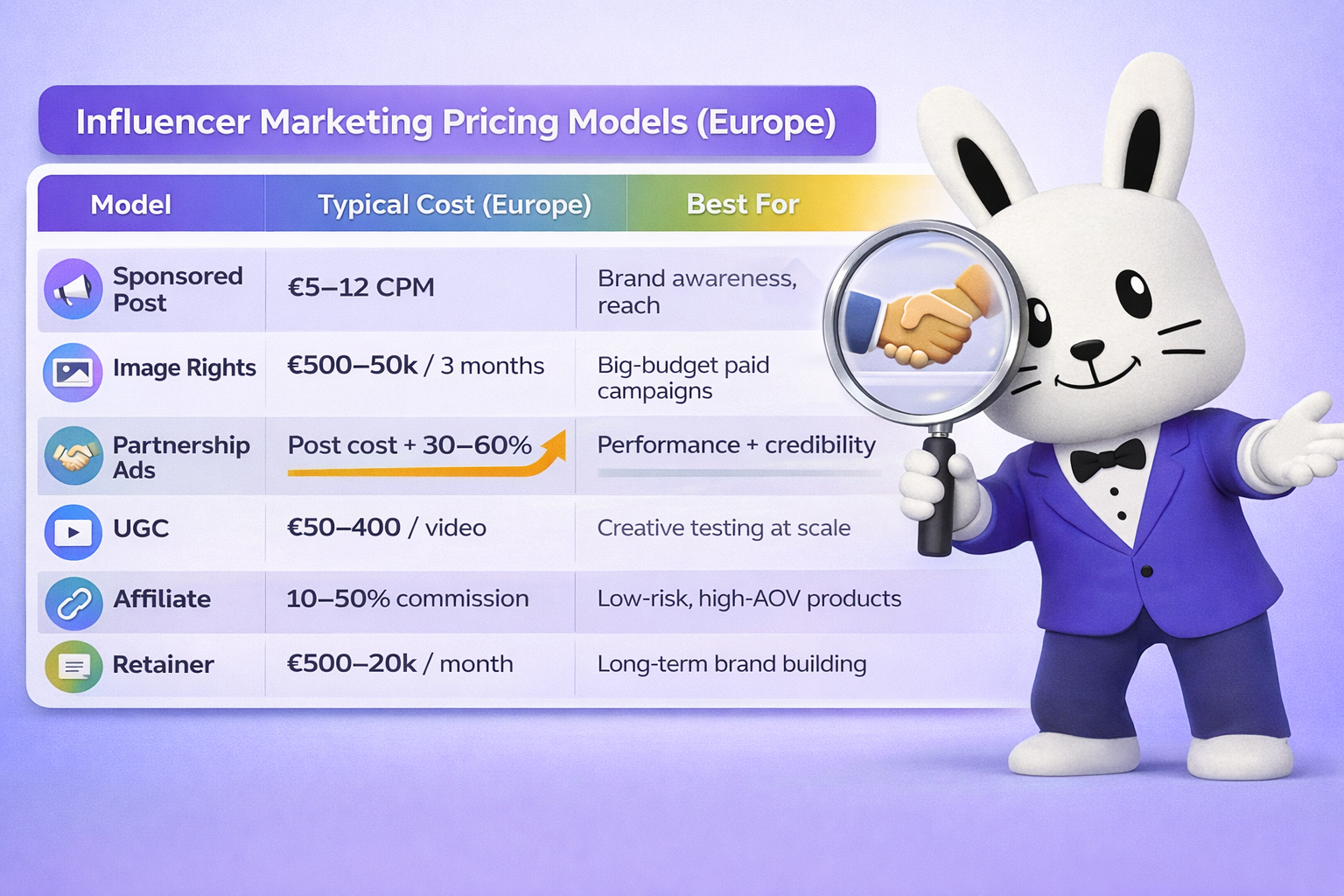
1. Sponsored Organic Post
You’re paying for impressions the influencer generates organically. Price it on a CPM basis (cost per 1,000 views), not per follower count.
Benchmark Rates
- USA: $8-20 CPM (depending on niche fit and authority)
- Europe: €5-12 CPM
- Poland / CEE: €3-8 CPM (growing market, still cheaper than Western Europe)
How to Price It Right
- Anchor your price to 70-120% of your Meta Ads CPM in the same market. If the influencer asks for more than 150% of your paid CPM, you’re likely overpaying - unless they have exceptional niche authority. To better understand how Meta campaigns are structured, see our complete guide to Meta advertising specs and formats.
- In the short-form era (Reels, TikTok, Shorts), follower count is meaningless. Evaluate based on the average views of the last 10-15 posts.
- Sponsored posts get fewer views than organic: ~30-40% less on Instagram, up to 60-70% less on TikTok. Factor this drop into your pricing calculations.
- YouTube mid-roll placements are safer - minimal view drop since the audience watches the video as a whole.
- Always ask for stats from previous sponsored collaborations, not general account analytics.
Pricing Formula
Estimated sponsored views = avg. views of last 15 posts × sponsor penalty (0.6 for IG, 0.35 for TikTok). Fair price = estimated views ÷ 1000 × your target CPM.
2. Image Rights for Paid Ads
You pay for the license to use the influencer’s face, voice, and name in your own paid campaigns. You’re not paying for their reach - you’re paying for their likeness.
Benchmark Rates
- Micro-influencers (10-50k): €500-2,000 for a 3-month license
- Mid-tier (50-500k): €2,000-10,000 for a 3-month license
- Macro/Mega (500k+): €10,000-50,000+ - heavily negotiated
How to Price It Right
- Only worth it for highly recognizable faces. If your target audience wouldn’t recognize the person at first glance, the image-rights premium is wasted.
- CPC improvement from using an influencer’s face rarely exceeds 5-15% vs. standard creative. Do the math before committing.
- Negotiate scope carefully: duration (3, 6, 12 months), platforms (Meta only? Google too?), and geographic markets. Unlimited licenses are significantly more expensive.
- Always A/B test influencer creative vs. non-influencer creative before signing a long-term deal.
Watch Out
Many brands overpay for image rights of mid-tier influencers. Start with a short test license (1-3 months) and extend only if you see a statistically significant lift in ad performance.
Before agreeing to a sponsored CPM, test the concept first.
Blumpo lets you generate performance-oriented ad variations around the same angle the influencer would use - different hooks, value propositions, positioning, and offers. You can run small paid tests to see what CPM and CTR you realistically achieve with that message.
If your paid creative struggles to hit acceptable numbers around that angle, paying a premium CPM to an influencer for the same message is unlikely to fix it.
Influencers amplify positioning. They don’t repair weak positioning.
Use Blumpo at blumpo.com to validate the angle first - then decide whether the influencer’s reach is worth paying for.

3. Partnership Ads (Spark Ads)
The ad runs from the influencer’s account (or as a tagged partnership), combining their credibility with your paid media targeting. This is called Partnership Ads on Meta, Spark Ads on TikTok, and BrandConnect on YouTube.
Benchmark Rates
- Typically: cost of a sponsored post + 30-60% premium for promotion rights
- Example: if the sponsored post costs €1,000, the partnership ads package will be €1,300-1,600
- Longer licenses (90+ days) allow for volume discounts of 10-20%
How to Price It Right
- Bundle the deal: content creation fee + promotion rights for a fixed period (30, 60, 90 days).
- CTR is typically 20-50% higher than standard paid ads with identical creative, thanks to the social proof effect. Factor this into your CPA calculations.
- The influencer’s post must stay live on their profile for the entire campaign duration - deletion kills the ad. Include this clause in the contract.
Best Value Model
Partnership ads only work if you can test and iterate fast. Blumpo turns influencer content into multiple performance-focused ad variations - different hooks, headlines, angles, and positioning - so you’re not betting your budget on one creative.

Instead of running a single Spark Ad and hoping it performs, you can systematically test 10-20 variations built from the same influencer asset. That’s how you turn credibility into predictable CPA.
4. UGC (User Generated Content)
The creator produces video or photo assets that your brand uses in its own channels. Content is NOT published on the creator’s profile. You’re paying for production, not reach.
Benchmark Rates
- Beginner UGC creators: €50-150 per video (15-60 sec)
- Experienced UGC creators: €150-400 per video
- Packages (3-5 videos): €300-1,500 with a 15-25% discount
- Add-on: paid ads usage rights: +30-50% on top of base price
How to Price It Right
- UGC is by far the cheapest way to get diverse creative assets for testing. For the price of one mid-tier sponsored post, you can get 5-8 UGC videos.
- Negotiate unlimited usage rights upfront - across paid, organic, website, and email - with no time limit.
- Platforms like Billo, Insense, and Clip let you scale orders from hundreds of creators simultaneously.
- Always order more variants than you think you need - marginal costs are low and more creative = better optimization in paid campaigns. Running the same creative for too long often leads to ad fatigue, which gradually reduces performance and increases costs.
5. Affiliate (Performance-Based)
The influencer earns a commission on every sale they generate through a unique link or discount code. Minimal upfront cost, but hardest to scale.
Benchmark Commission Rates
- E-commerce (fashion, beauty, lifestyle): 10-20% of order value
- SaaS / subscriptions: 20-40% of first payment or recurring
- Digital products / courses: 20-50%
- Hybrid model: 30-50% of standard fee as base + 5-15% commission
How to Price It Right
- Pure affiliate rarely attracts quality influencers - it shifts all risk onto them. Use a hybrid model: small base fee (30-50% of normal rate) + commission as a performance bonus.
- Set a long attribution window: minimum 30 days, ideally 60-90. Influencer marketing is top-of-funnel; conversions can happen weeks later.
- Works best for high-AOV categories with good margins: premium fashion, SaaS, finance, online education.
- Avoid pure affiliate with influencers under 100k followers - their reach is too small to generate meaningful sales volume.
Common Mistake
Don’t expect top influencers to accept pure commission deals. Treat affiliate as a bonus motivator on top of fair compensation - otherwise you’ll only attract low-quality creators.
6. Retainer (Long-Term Partnership)
A fixed monthly fee for an ongoing relationship: a set number of posts, stories, and reels per month over 3-12 months.
Benchmark Rates
- Micro-influencer (10-50k): €500-1,500/month for 2-4 posts + stories
- Mid-tier (50-500k): €1,500-5,000/month
- Macro (500k+): €5,000-20,000+/month
- Volume discount: -15% for 6-month commitment, 25% for 12 months
How to Price It Right
- Negotiate 15-30% lower per-post rates compared to one-off collaborations. The trade-off: the influencer gets guaranteed income and a longer relationship.
- Start with a 3-month pilot with clear KPIs. Extend to 6-12 months only if results justify it.
- Bundle partnership ads rights into the retainer - this is the most powerful combination in influencer marketing.
Sources:
- https://blumpo.com/
- https://scrollyapp.io/
- https://price-estimator.impulze.ai/
- https://influencity.com/blog/en/decoding-influencer-pricing-an-agencys-guide-to-fair-market-value